


)
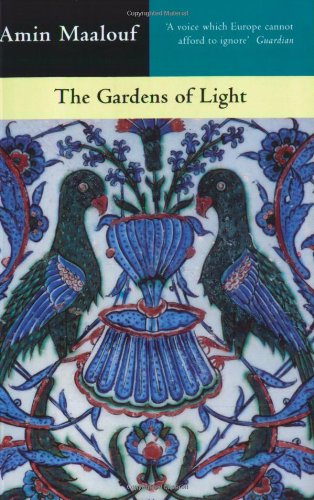
Born in a Mesopotamian village in the third century, the son of a Parthian warrior, Mani grows up in a volatile and dangerous world. As battle rages for control over the Middle East between the great Roman and Persian empires, as Jews and Christians, Buddhists and Zoroastrians fight for ascendency, Mani- painter, mystic, physician and prophet- makes his way through the battlefields to preach to his incandescent doctrine of humility, tolerance and love, a doctrine that comes to be known as Manicheanism. A vivid glimpse of the ancient world in all its perfumed splendour and cruelty, an elegantly philosophical discourse on the fall of man, THE GARDENS OF LIGHT is a story of great beauty and resonance, exquisitely told.


Related posts:
 SUPERNIGHT 2M 20LEDs Cool White Soft Wire LED String Light 3*AA Battery Operated DIY Creative Novelty LED Starry Starry Light Holiday Festival Christmas Mini Light String Fairy LED Lights for Gardens, Homes, Christmas, Partys, Weddings Decorative Flexible LED Rope Light
Easy Gardens Volume 16 – Wildflower Meadow Plus Wildlife & Eco-Friendly Gardens (Easy Gardens A to Z)
Easy Gardens Volume 17 – Romantic and Cottage Gardens (Easy Gardens A to Z)
Sunterra 300309 Submersible Light Kit for Water Gardens, Three Lights with Transformer, Black
Sunterra 300209 Submersible Light for Water Gardens and Ponds, Black
The Garden Source: Inspirational Design Ideas for Gardens and Landscapes
SUPERNIGHT 2M 20LEDs Cool White Soft Wire LED String Light 3*AA Battery Operated DIY Creative Novelty LED Starry Starry Light Holiday Festival Christmas Mini Light String Fairy LED Lights for Gardens, Homes, Christmas, Partys, Weddings Decorative Flexible LED Rope Light
Easy Gardens Volume 16 – Wildflower Meadow Plus Wildlife & Eco-Friendly Gardens (Easy Gardens A to Z)
Easy Gardens Volume 17 – Romantic and Cottage Gardens (Easy Gardens A to Z)
Sunterra 300309 Submersible Light Kit for Water Gardens, Three Lights with Transformer, Black
Sunterra 300209 Submersible Light for Water Gardens and Ponds, Black
The Garden Source: Inspirational Design Ideas for Gardens and Landscapes
A beautifully written, heartbreaking book. The Gardens of Light is the sort of book which lingers in one’s mind long after he has set it down. A historical novel, it reconstructs the life and trials of Mani, the true life third century prophet of a new religion, Manichaeism. A sophisticated religion which sees “light” and “darkness” in all things, and creation itself the product of their mixture, Manichaeism is unique in that it respects all religions and their prophets, whether Jesus or the Buddha. The title itself is an allusion to mani’s conception of heaven, a “garden of light.”
A Novel of Mani I read Amin Malouf’s historical novel “The Gardens of Light” after reading Paul Kriwackek’s high praise for it in his recent book about Zoroastrianism, “In Search of Zarathustra: Across Iran and Central Asia to find the Worlds’ First Prophet.” Maalouf has written a rare book about a historical period and figure that will be obscure to many readers. He has told an inspring story that may keep readers awake through many a late night.”The Gardens of Light” was Maalouf’s first novel. He is a Lebanese author who writes in French and now lives in France. The book has been ably translated by Dorothy Blair who also provides a useful chronology of Mani’s times. I am told by a friend who reads French that Maalouf writes in a highly formalized, literary style unusual among current French authors.Mani (216-274 A.D.) was a Persian prophet and mystic, the founder of a teaching known as Manichaenism, which attracted many followers, East and West, for centuries before dying out. Little is known of Mani’s life. But Maalouf has woven a beautiful story of Mani which integrates the sparse details of his life with a history of the dynasties of Persia. Maalouf’s book is a meditation on religion, philosophy and art. His novel shows the dualism — the belief that the world is a battleground between forces of good and pure light and evil and that it is man’s work to strive for the triumph of good — that was Mani’s most famous (and notorious) teaching. Maalouf also shows Mani as a syncretist — a thinker who tries to combine the best of a number of seemingly disparate religious systems. In Mani’s case, his doctrine is primarily a synthesis of Zoroastrianism, Buddhism, and Christianity. Maalouf also shows Mani as a pacifist, artist,vegetarian, and follower of the life of the intellect.In Maalouf’s telling, Mani spends most of the first 24 years of his life in a small Christian ascetic community known as the Palm Grove of the White Clad Bretheren. Mani’s father, Patek, had abandoned his pregnant wife, Mariam, to join the Bretheren, and Mani is abducted as an infant to live in the Palm Grove. He reads in the library, learns of his genius as an artist, and hears prophetic voices from his “other” which precipitate his leaving the Order at the age of 24.Mani begins spreading his message of peace, the equality of religions, toleration, dualism, and beauty. He travels to India and forms a friendship with Hormisdas, the liberal-minded younger son of the Sassnian ruler, Shapur. He also incurrs the lasting enmity of the priestly caste and of Bahram, Hormisdas’ older brother. The Persian King Shapur grants Mani an audience, allows him to preach, and the two form a tortured and difficult friendship, as Mani’s message becomes entangled with a well-meaning ruler and with war and the ways of the world. The favor Mani enjoys comes to an end with the ascension of Bahram to the throne, following Shapur’s death and the assassination of Hormisdas. Many is tortured and put to death.This book gives an excellent picture of the Persian dynasty, readily accessible to those with no background in this area. There is an intriguing treatment of the relationship between Persia and the latter Roman Empire. Maalouf also offers a nuanced picture of Zoroastrianism, noted by Paul Kriwackek in his study. But the book is ultimately about Mani and his message and his failed dream. As Maalouf portrays it, Mani’s vision retains its power to stimulate the mind and move the heart. The teachings of beauty, mind, peace, and religious synthesis will remain in the reader’s mind long after completing this outstanding novel.Robin Friedman
Comments are disabled for this post.